

Both tariffs and electricity have been in the news a lot this year.
The president’s “America First” trade policies have led to new and increased tariffs on specific imports and entire countries.
Meanwhile, U.S. electric demand has soared to the highest levels seen in two decades.
The average American probably doesn’t think about how trade policies or the demand for electricity may impact their day to day. But with the high inflation of the past several years and slowing U.S. wage growth – inflation has grown faster than the wages of middle- and lower-income earners since January, according to economic insights data from Bank of America – many Americans are thinking about their wallets.
So, do tariffs impact the cost of electricity?
“While tariffs have increased utility material costs a bit, we have not seen any sort of drastic inflationary price increases related to tariffs and hope this continues,” says Matt Brandup, president and CEO of RESCO, a member-owned, not-for-profit cooperative that provides high voltage electric distribution and transmission supplies.
However, the “increasingly unpredictable nature of U.S. trade policy” creates long-term implications for U.S. trade relationships, according to CoBank, a national cooperative bank serving vital industries, including agribusiness, power, water and telecommunications, across rural America.
 DOMESTIC PRODUCTION, IMPORTED RAW MATERIALS
Of all the materials RESCO supplies its member-cooperatives, 80% is domestically produced.
“I am very proud our industry can say that,” Brandup says, which has helped minimize tariff impacts on electric utility supplies.
Some materials which have been impacted by tariffs include overhead and underground cable conductor, which carries electric current through power lines, and raw materials used in electric utility finished goods, including aluminum, copper and steel.
“The steel, aluminum and copper, to some degree, do impact the costs of the material we sell, even if it is produced in the United States,” Brandup says.
North Dakota’s neighbor to the north is the top supplier of both steel and aluminum to the United States. Canada supplied the United States with $7.1 billion in steel and $9.4 billion worth of aluminum in 2024.
There is a 50% tariff currently on imported aluminum, copper and steel, including from Canada, with few exceptions. Aluminum and steel originating from the United Kingdom is subject to a 25% tariff, and Russian aluminum is subject to a 200% tariff.
“As with all products that potentially could be impacted by enacted or proposed tariffs, the cost of the equipment and supplies we sell could increase, depending on the country of origin of the imported finished product or the raw materials imported to manufacture the product here in the United States,” Brandup says.
“Most of us are going to be exposed at least partially to the pile-on in tariffs, and that’s because ‘made in America’ can still rely upon components that are being sourced from some other country,” says Teri Viswanath, lead economist for power, energy and water in CoBank’s Knowledge Exchange research division.
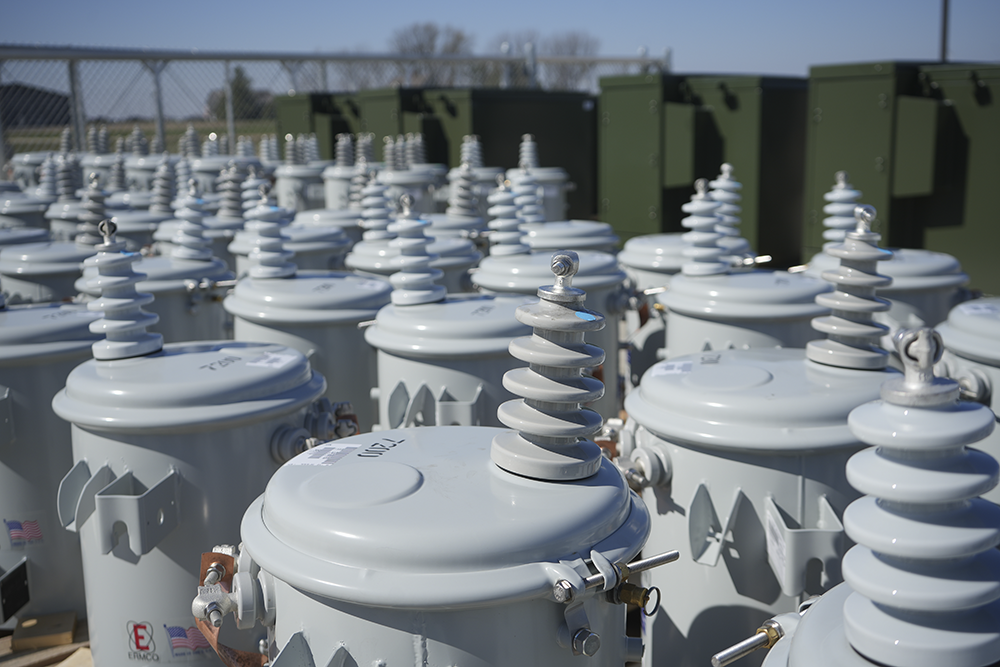
One example is electric transformers, which step up and down voltage at various junctures in the electric delivery process.
Although most of the smaller and medium power transformers are produced domestically, the primary components used in them are largely foreign sourced. In 2020, the U.S. Department of Commerce determined the levels at which these components were being imported threatened national security.
China and Hong Kong together accounted for 45% of global exports of electric transformer parts, Viswanath says.
“Without a doubt, the U.S. rewiring of global trade will add cost pressures to an already overheated utility procurement market,” Viswanath says. “The fact is that the U.S. power grid needs substantial investment, and with so much of the supply chain imported, that price tag is rising.”
TIME WILL TELL
As U.S. trade policies continue to evolve, time will tell whether or not tariff practices will ultimately impact the price of electricity.
“Anything that raises the prices of the material we sell to our members can certainly impact and raise the price of electricity. When our members have to pay for the material they use to serve their members and provide electricity to them, those increased costs have to be taken into account into the price of electricity,” Brandup says.
Being an electric cooperative member also has its advantages.
Electric cooperatives are not-for-profit electric utilities which are owned by the members who use the electricity the co-op provides. All “profits,” called margins, are either reinvested into the cooperative’s system or returned to members in the form of capital credits. Unlike other utilities, cooperatives do not profit from the people who use their electricity. Thus, electric cooperative members are protected from paying costs above what is required to provide the electricity.
Other good news is much of the supply chain issues seen during and following the pandemic of 2020 have resolved and the historic inflationary pricing of recent years has slowed and retreated, Brandup says.
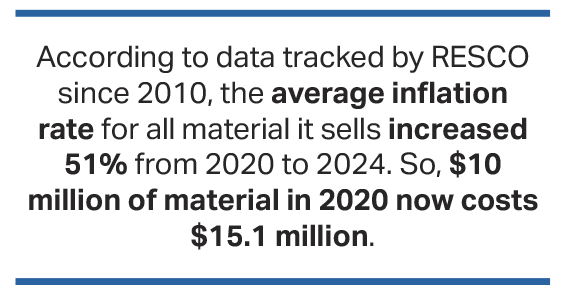
According to data tracked by RESCO since 2010, the average inflation rate for all material it sells increased 51% from 2020 through 2024. A utility purchasing $10 million of material in 2020 now pays $15.1 million for the same material in 2025.
“Now, we’re seeing the inflation rate more in-line with pre-COVID levels,” Brandup says.
___
Cally Peterson is editor of North Dakota Living. She can be reached at cpeterson@ndarec.com.