

Sixty years ago, Basin Electric Power Cooperative completed construction on Unit 1 of its first power plant, Leland Olds Station near Stanton. At the time, it was the largest lignite coal plant in the Western Hemisphere.
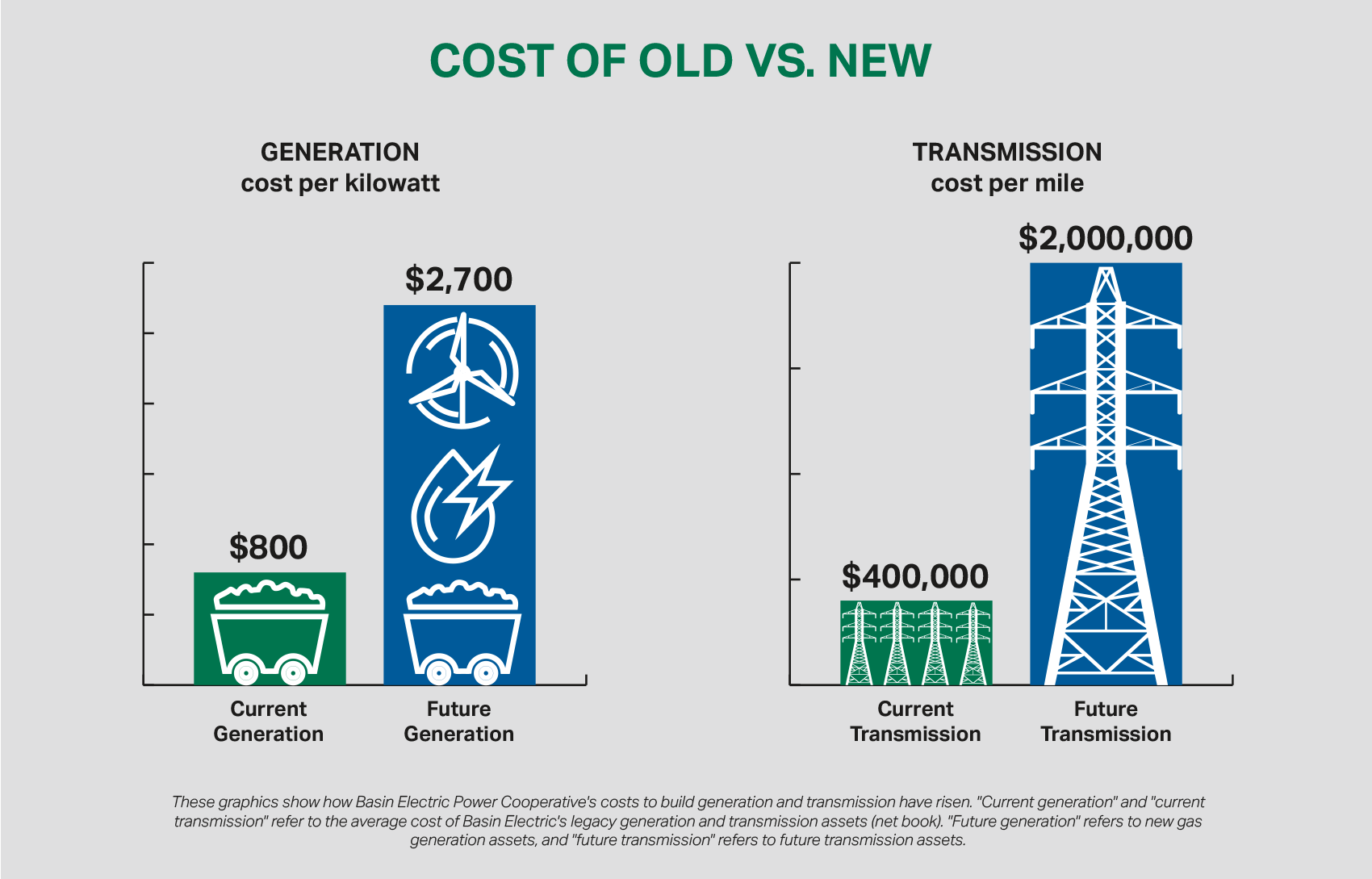
It cost $36 million – or about $167 per kilowatt (kW) – and provided cooperative members with about 216 megawatts (MW) of coal-fueled power. To build a similar natural gas-fueled power plant today, costs have risen to $2,700 per kW, or approximately $583.2 million.
As the costs to build and maintain electric infrastructure continue to rise, so has the demand for power.
Over the past 15 years, Basin Electric has seen a near-doubling of its electric load, which is the amount of electricity needed to serve its 3 million members across 139 member systems in nine states.
As a result, the Basin Electric board of directors announced in September a 10% wholesale power rate increase beginning Jan. 1. The cooperative cites this growth in traditional load and reliability investments as drivers of the rate increase, as well as variability in commodity prices and increased planning reserve margins required by its regional transmission organization or RTO, Southwest Power Pool (SPP).
“We understand and recognize the impact this (rate increase) has on our members and their communities. This decision was not made lightly,” says Andy Buntrock, Basin Electric vice president of strategic planning and communications. “Basin Electric is thoughtfully working to balance our goals of providing reliable and affordable power, while maintaining a financially viable cooperative.”
Another regional power supplier, the Western Area Power Administration (WAPA), which supplies hydropower to many electric cooperatives in North Dakota, also passed on a 6% rate increase effective Jan. 1. WAPA says capital investments, including infrastructure upgrades and new transmission projects, and rising equipment, labor and purchased power costs are major drivers of the rate increase.
It all boils down to reliability, the cooperative’s “North Star,” Buntrock says.
“A rate increase helps provide the resources needed to invest in infrastructure and technology and maintain and upgrade equipment. These investments ensure the system stays strong and reliable, providing members with dependable electricity for their homes and businesses,” Buntrock says.
INFRASTRUCTURE INVESTMENTS AND LOAD GROWTH
Basin Electric’s energy portfolio has grown from a single coal unit providing 216 MW of power in 1966 to 8,427 MW of winter generating capacity from a diverse mix of natural gas, coal, wind, hydro, solar, recovered energy, fuel oil and market purchases.
“This balanced approach ensures reliable and affordable energy for our members, regardless of weather conditions,” Buntrock says.
Several factors have necessitated recent and future investments in generation and transmission infrastructure.
When Basin Electric joined SPP in 2015, the planning reserve margin (PRM) was 12%.
The PRM ensures there is additional generation on the grid to serve the load if there are constraints on fuel, transmission or generators, which can happen during extreme weather conditions.
Beginning this summer, the cooperative’s PRM will be 16% for summer months and 36% for winter months.
“It’s similar to your insurance agent showing up one day saying you need to double the amount of coverage you have on your vehicle, or you cannot drive it,” Buntrock explains.
Another reason for investments is to support growth in the cooperative’s traditional load, which includes a mix of agriculture, oil and gas, ethanol, manufacturing and residential demand, and is projected to increase each year for the next decade.
Data centers are not tied to Basin Electric’s 2026 rate increase, the cooperative says.
“While large loads such as data centers and crypto mining are a hot topic across the nation, they are not behind the 2026 rate increase. In collaboration with its membership, Basin Electric developed the Large Load Commercial Program, designed to help insulate our existing members from the costs and risks associated with serving new large loads,” Buntrock says.
| LARGE LOAD PROGRAM |
|---|
In June, Basin Electric Power Cooperative rolled out its Large Load Commercial Program, which was developed in response to the growing number of “large load” requests. “Large loads,” such as data centers and crypto mining facilities, use large amounts of electricity. Historically, 3 megawatts (MW) or 5 MW was considered a “large load,” but requests today ask for 50 MW, 100 MW or more. The Large Load Commercial Program ensures new, high-demand customers pay their fair share of costs, helping to insulate members from the investment and ongoing expenses of serving large loads. “It took over a century to build the infrastructure that serves the current electric needs of our communities, yet we are now being asked to match that scale of development in just a few short years,” says Andy Buntrock, Basin Electric vice president of strategic planning and communications. “This program is not designed to be a barrier, but rather a tool to support members navigating this significant large load growth.” As these non-traditional loads can require significant investments in generation and transmission infrastructure, the program requires those requesting service to bear the financial responsibility for the resources needed to serve them. The program was designed to: • Help minimize rate impacts to existing members. • Reduce the risk of stranded assets. • Protect Basin Electric’s credit rating and create opportunities to raise capital responsibly. • Offer flexibility in serving large loads. • Establish a clear, consistent process. “This approach helps responsibly serve these new energy-intensive industries, while helping insulate our members from electric cost increases associated with these large loads,” Buntrock says. “It ensures the cost causers are the cost payers.” |
Basin Electric’s investments in capital expenditure projects over the next 10 years are expected to total approximately $11 billion, which will more than double the cooperative’s balance sheet, increasing dispatchable generation by 50% and expanding transmission mileage by more than 30%.
In addition to the 580-MW Pioneer Generation Station Phase IV natural gas plant completed in August, Basin Electric will be building a 1,490-MW natural gas plant, Bison Generation Station, slated to be energized in 2030. Basin Electric also expects to complete the 160-mile Leland Olds Station to Tande transmission project this year.
While reliability investments are necessary, they have become significantly more costly in recent years due to inflation and supply chain pressures.
The legacy cost of Basin Electric’s generation fleet averages $800 per kilowatt, and transmission averages $400,000 per mile of line. To build new infrastructure today, it costs Basin Electric approximately $2,700 per kilowatt and $2 million per mile of line, Buntrock says.
WAPA and Basin Electric are also collaborating on significant transmission upgrades in the region.
A new 439-mile, 345-kilovolt (kV) line from Belfield to South Dakota and into Wyoming will bring large economic benefits to North Dakota and the region, addressing the extra high voltage deficiency in the area and benefitting rural communities from the western Dakotas to Nebraska, WAPA says.
Another major transmission project is a new 230-kV line from Dawson County, Mont., to Williston, which will add transmission capacity to a bustling oil and gas region.

RELIABILITY AND AFFORDABILITY
Wholesale power costs account for the largest share of a North Dakota distribution cooperative’s operating expenses. On average, 66 cents of every dollar members pay for electricity goes toward the cost of power.
When an electric cooperative faces wholesale power rate increases, like Basin Electric’s or WAPA’s 2026 increases, locally elected boards of directors and management face decisions.
Cooperatives regularly hire independent, third-party consultants to perform cost-of-service studies, which help boards set rates that are fair, equitable and cover the costs of building and maintaining the cooperative and its local system.
The board weighs many factors when determining rates, including load growth and revenue projections, construction workplans and reliability investments, labor and wholesale power costs, financial reserves and capital credits, and impacts on the membership.
When an electric cooperative board of directors votes to increase rates, directors are also raising their own electric rates, because they, too, are members of the cooperative. This is one of the hallmark advantages of the cooperative model, Buntrock says.
“You cannot get any closer to member control than the cooperative model,” Buntrock says. “Literally the people that use the product also own the operation, allowing the cooperative to plan in quarter centuries versus the next quarter and the current stock price.”
The cooperative model of electric service has served rural communities for 90 years, and Buntrock says it is poised to do so well into the future.
___
Cally Peterson is editor of North Dakota Living. She can be reached at cpeterson@ndarec.com.