
At harvest time, I find myself thinking about all the harvest-related radio and television stories I did over the years. There were stories about bumper harvests and poor harvests, about wet, difficult harvests, profitable harvests and unprofitable harvests. There were stories, too, about getting the harvested crop to market. In 1974, one of the stories I did was titled “Boxcar Shortage.” There would be others in succeeding years with the same title.
The railroad mainlines stretched westward across the state in the late 1800s and the network of branch lines was completed by 1916. For generations, the country elevators that sprang up along those main and branch lines relied on a steady supply of 40-foot wooden boxcars to move the grain farmers brought to the elevators.
The railroads would “spot” or park a handful of boxcars on the siding adjacent to a country elevator, then do the same at the next elevator in town and at the elevators in every small town along the line. When the elevators had filled the boxcars, the trains picked them up and replaced them with empties. But during harvest, there were seldom enough cars. It might have taken only four loads from single-axle farm trucks in 1974 to fill a boxcar. The railroads couldn’t keep up.
Just a few years after that, the railroads began moving toward jumbo, covered hopper cars. Each could hold 4,000 bushels of wheat. Not only were the cars much bigger, but they were connected into 100-car unit trains – trains that stayed connected. Small country elevators were replaced by huge mainline sub-terminals that could hold millions of bushels and efficiently load those unit trains. The railroads began abandoning branch lines. One of the harvest stories I did in 1985 was about the impact of abandoning the branch line that had served Zeeland for 82 years.
With all the changes, the efficiency of moving grain by rail has increased exponentially. But so has the farmer’s ability to harvest, with large fields, large combines and semitrucks. Now, four semi loads fill a covered hopper car.
For decades, country elevators were often full at harvest time, waiting for boxcars. Today, the sub-terminals are often full, waiting for unit trains.
___
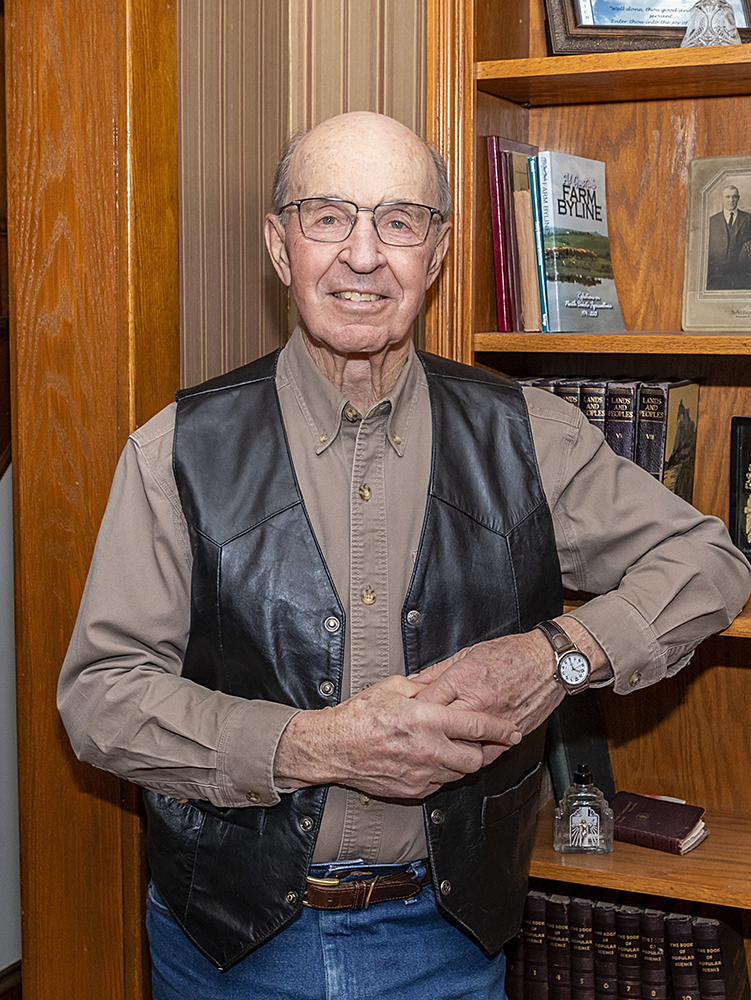
Al Gustin is a retired farm broadcaster, active rancher and a member of Mor-Gran-Sou Electric Cooperative.