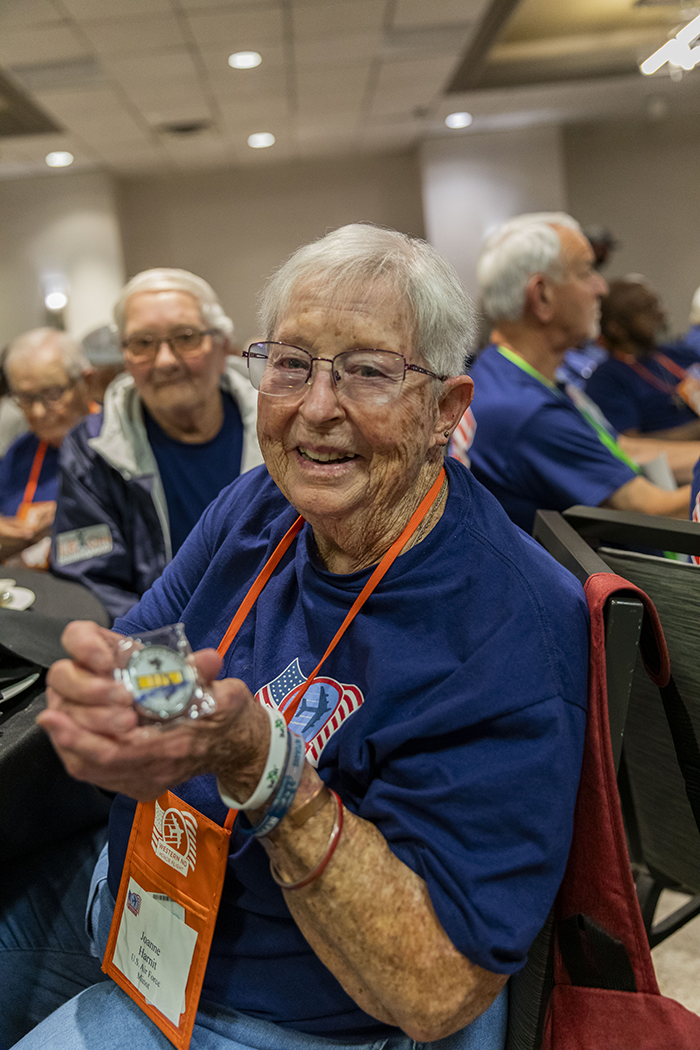

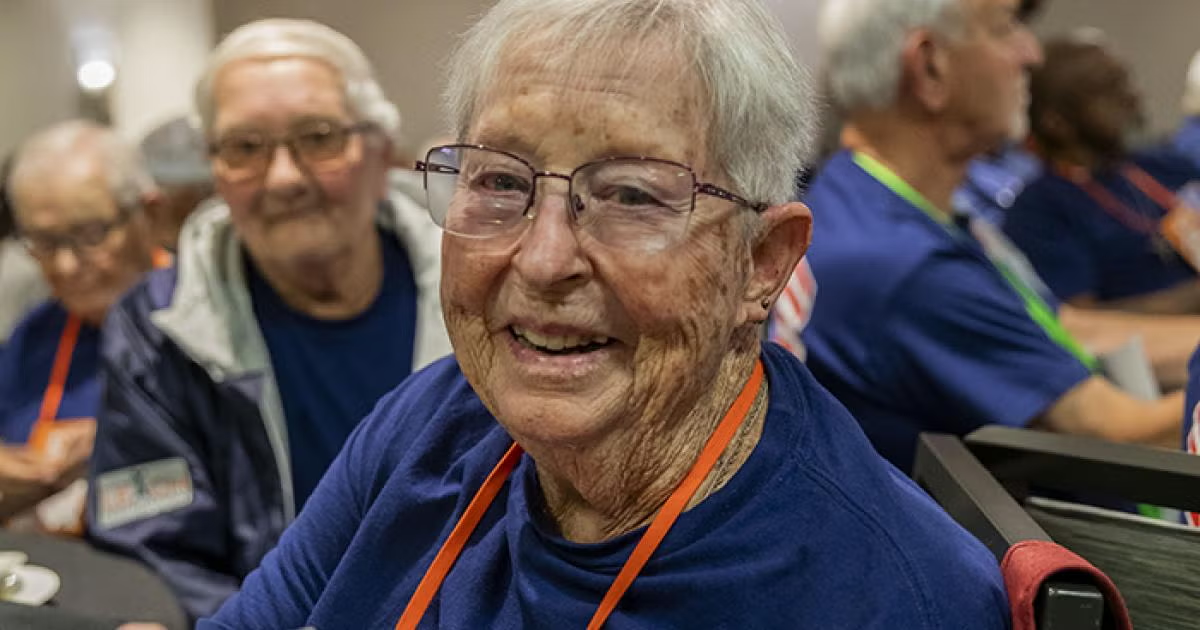
Joanne Harnit, Minot, and all the veterans aboard the Western ND Honor Flight received a military challenge coin to commemorate their trip at the evening banquet. Photos by NDAREC/Liza Kessel
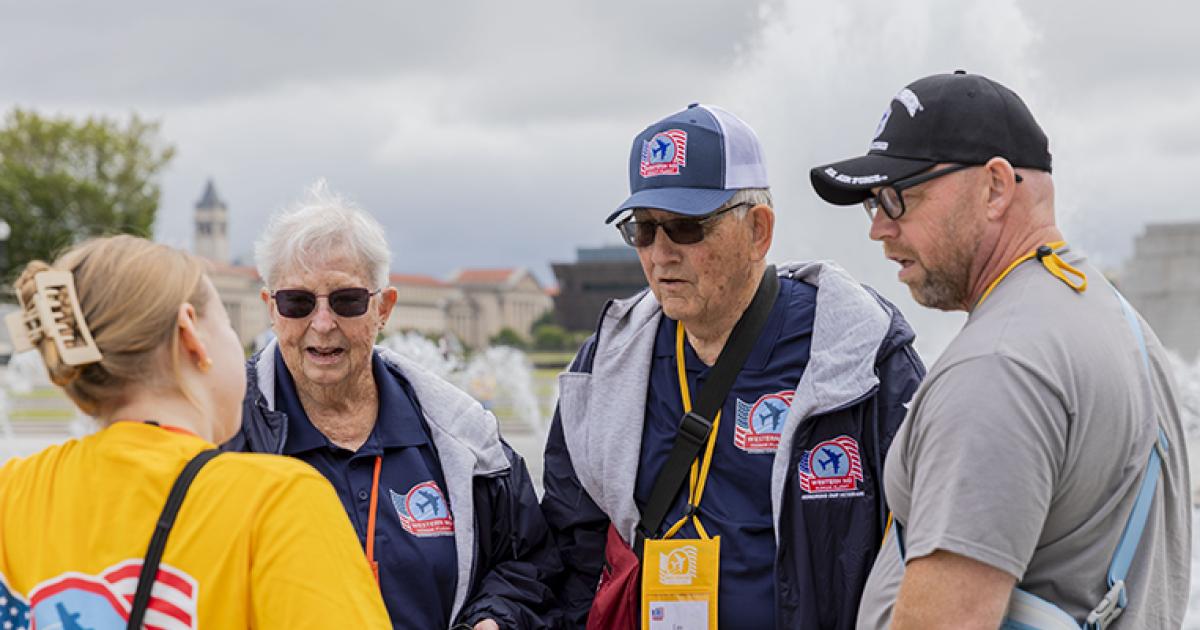
“Mail call!”
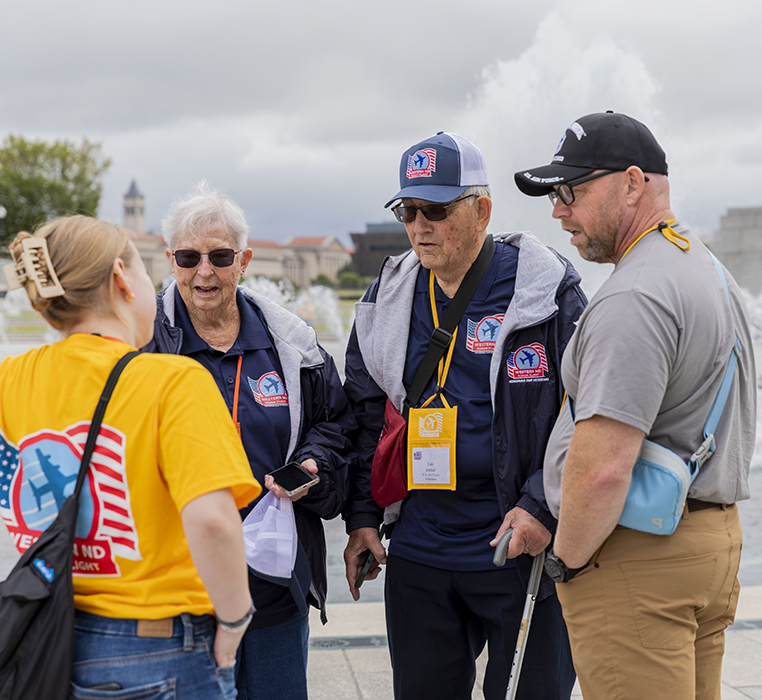
A voice rings out in a banquet room where more than 100 veterans are passing around stories of their military service. Their feet are tired from the journey that started before dawn at the Bismarck airport. But their minds and memories are youthful again in this space of shared experience and unspoken understanding. Murmurs of delight follow the mail delivery from table to table, a tradition on the Western ND Honor Flight journey.
Joanne Harnit isn't expecting anything, but it doesn’t dim the joy she feels to be here. Harnit never married or had children.
“My sister had five. My brother had four, and I took care of 25 a day at the pediatric clinic,” the retired pediatric nurse practitioner jokes."
After 20 years in the U.S. Air Force, a civilian career at an air medical base in Wyoming and winters spent traveling the Southwest in her RV, Harnit spent more than 60 years away from her family in North Dakota.
Letters and old friends
A manila envelope is delivered at Harnit's placesetting. Inside, handwritten letters from school children she’s never met tell her they are grateful for her service, along with messages from her nieces, nephews and their children.
“I had letters in there from family that were really meaningful,” she says. She recently moved back to Minot to attend their activities and watch them grow. In return, they’re beginning to learn more of Harnit’s story of service.
“Leo Jostad?” The voice rings out again.
Harnit's ears perk up. She and Jostad graduated from Bottineau High School together and entered the Air Force the same year.
“He was shaking. He was so excited because there was someone he knew there,” she says.
Service and understanding
In 1957, many of the girls in Harnit’s graduating high school class had limited options to pursue a career.
“When I was growing up, women could be nurses, teachers, office people, work in a store or be a wife and mother,” she says. She graduated from St. Andrew’s Hospital School of Nursing in Bottineau in 1960.
A few years later, at age 22, Harnit was thinking mostly of the adventure ahead of her when she enlisted in the Air Force, underwent orientation for nurses and medical officers at Gunter Air Force Base in Alabama and volunteered to help fill the need in pediatric nursing.
She cared for infants and children in air medical bases in the United States, England and Italy. But in 1969, her reassignment would take her away from pediatrics and into the heart of war.
She spent a year in an aeromedical evacuation holding center at Da Nang Air Base in Vietnam, caring for wounded service members awaiting transfer to larger hospitals. Most stayed only for a night. Still, she knew the holding center represented comforts the men had long gone without: “hot water, television, sheets and hot food.”
Youth and the weight of war
“I was caring for older children at that point,” she explains. “These troops were 18 years old, 21. They loved the fact that they could watch the football game on TV.”
Most of her nurses were the patients’ age. Harnit already had several years of experience working in hospitals, but many of these women had only just entered the Air Force when they were sent to Vietnam.
“They would cry after doing their job,” she remembers. “They wouldn’t socialize with other people because they were so upset. You were giving them support as well as giving patients support.”
While Harnit cared for her patients, her high school classmate, Leo Jostad, was dodging enemy forces in the airspace above. Though Harnit never witnessed the combat that bonded these men, she saw the impact of it. Wounded troops carried and washed their injured brothers. Their promise was not only to their country, but to each other.
Remembrance and reflection
Back in the banquet room, Harnit stays after many veterans retired to their rooms. She and a few others visit with sentinels who guard the Tomb of the Unknown Soldier around the clock.
The image stays with her after she returns home to Minot. So does the expanse of Arlington National Cemetery. The rows of white stones in this national resting place are both simple and impossible to fully understand.
There was no way for Harnit to know what became of the men she cared for in Vietnam, or whether any of them are now remembered in Arlington. Her role was never to know the ending of every story, but rather to help carry each patient through a difficult chapter. She and thousands of other nurses stood watch over unwritten futures. But in Arlington, the sentinels stand watch over memory.
___
Hope Sisk is managing editor of North Dakota Living. She can be reached at hsisk@ndarec.com.